
Our History
Enlivened by the Holy Spirit, we advocate Peace and Justice for the Common Good in light of the Social Mission of the Church.
SSS Mission Statement, Adopted Pentecost 2017
The Beginnings of the Sisters of Social Service
Our Roots

We trace our roots back to 1908 in Hungary where our founding members were inspired by the Church’s first great encyclical on social justice, Rerum Novarum (On the Condition of Labor). Sister Margaret Slachta was a pioneer in the field of social work. In 1920 she was elected the first woman member of the Hungarian Parliament, where she actively promoted workers’ rights, stressing the well-being of women, children and families.
In 1923 she formally founded the Sisters of Social Service (SSS) and adopted the social mission of the Church as the motivating thrust of their lives. They embraced Benedictine spirituality and had a special devotion to the Holy Spirit. After spiritual formation and professional training, they dedicated themselves to responding to the needs of those who were socially, economically and politically powerless. They believed that they should not only work to heal the wounds of society, but should spend their lives trying to change the conditions that caused the wounds.
During the 1920’s the SSS spread from Hungary to neighboring Romania and Slovakia, as well as to Canada and the United States. Sister Frederica Horvath came to Los Angeles, California in 1926 and planted the spirit and mission of the Sisters of Service that we live today.
Watch the Documentary on our First Hundred Years
Coming to America
The world has radically changed since Sister Frederica Horvath and two other sisters immigrated to the United States from Hungary, and in 1926 founded the Sisters of Social Service in Los Angeles. That was the year that Bishop J. J. Cantwell of Los Angeles invited the Sisters of Social Service to work in his diocese and gave for their temporary use the “Little Brown House” at 707 West Second Street. Back then the population of Los Angeles was just 980,000.
Music could be heard from band concerts at the plaza in downtown Los Angeles or on Olvera Street, or of course from the Victrola at home. In retrospect that long-gone world was hardly prepared for Sister Frederica! In those days, most nuns wore long black veils and stayed in convents. The Sisters of Social Service were different. They arrived on the scene, harbingers of change, wearing simple gray dresses, and working independently and directly with the people, because the Community saw itself as called to be in the world, amongst the people whom they served.
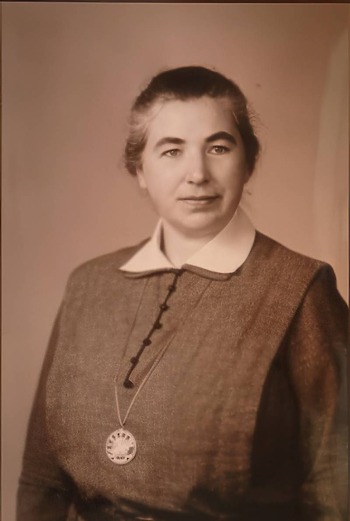
Sister Frederica Horvath’s Story
Sr. Frederica was born in Hungary in 1897, the fifth child of Maria Terezia Heger and Tivador (Theodore) Meszaros. World War was soon upon them, and it was a tragic period in the life of her country, as well as her own. After three and a half years in a Russian prison camp, her husband, Joseph Horvath, escaped and made his way home shortly before the Armistice. He reached his wife in September 1918, and on November 1 was shot by a half-crazed soldier in the streets of Budapest. He died a month later, but not before Frederica herself was hospitalized with influenza, which was taking a heavy toll of lives. Her mother had died when she was four, and her father-in-law in 1916, her father in 1917, and now her husband was dead. She pondered why she had been spared.

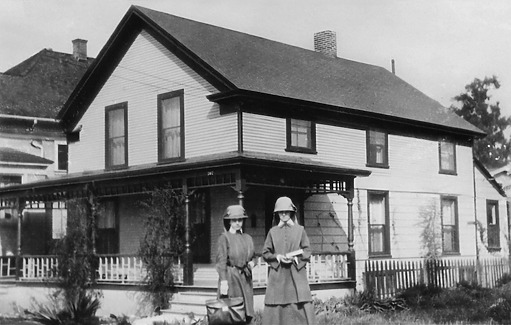
As the community grew, so did their need for more room. With the approval and encouragement of Bishop Cantwell, negotiations began and 1120 Westchester Place was purchased as the Motherhouse and headquarters for the Sisters of Social Service. The financial obligation for this purchase was far beyond the means of the little group of Sisters, and so began the creation of the Social Service Auxiliary which to this day, is a major source of support and friendship to the Sisters. Thus the Sisters were poised to continue their important work in the community, which continues today.

In those early years, the Sisters’ work began with helping families new to the United States with immediate and transitional needs, and soon children’s groups were formed. As other young women joined the Sisters, their mission expanded to include catechetical and census work in parishes. Soon, the children in the juvenile detention center were also being served. Next, three new ministries were added: Stella Maris, initially a residence for working women; Camp Mariastella, a youth camp and retreat location; and a spiritual retreat program, offering days of prayer and meditation.
International Expansion

Within time, new ministries were started throughout the United States. By 1946 the Sisters had established a presence in Shanghai, China, which was the Sisters of Social Service Los Angeles’ first international endeavor. In 1963 our Sisters began ministries in Mexico and Taiwan, and in 1994, we expanded our works to serve the people of the Philippines as well. Currently, our Sisters work in these four countries, and are connected in mission and charism to the International Federation of the Sisters of Social Service, whose 300 members improve the lives of people in need throughout the world.
The road has not always been easy for the Sisters of Social Service. We were driven out of Shanghai during the political tumult of the 1950’s, and the SSS were also active in Hungary during World War II. Sister Sara Salkahazi and Sister Margaret Slachta, among others, helped to save over a thousand lives by providing “safe houses” and protection to Jewish refugees fleeing for their lives during the holocaust.
Ministries & Collaboration

The SSS ministries address the needs and challenges of those struggling individuals and families living in poverty. We have always had a special emphasis on women and children living on the margins of our community. Our Sisters have brought direct social services, community development and systemic support to hundreds of thousands of people in need. We work with people from diverse backgrounds and cultures to build a better future together.
Since 1936 the Sisters of Social Service have worked to address the immediate and long-term needs of people living in poverty. We provide direct social services at centers, camps, shelters, private practices and other non-profits in communities around the world. Additionally, we support local communities and collaborations to empower individuals and transform neighborhoods, while working to create systemic change by educating everyone we meet about the lived realities of the poor and advocating for greater support.
The Present
In 2005, after an extensive renovation of our property in Encino, the Administrative Offices for the Sisters of Social Service moved there, joining Holy Spirit Retreat Center and the “Villa” retirement home for our aging sisters, with beautiful new facilities. These new facilities include the completely renovated Retreat Center, expanded office and conference spaces for our administration and staff, including Camp Mariastella, temperature-controlled historical archive rooms and a new chapel.
More information about Holy Spirit Retreat Center ›
Today, the Sisters remain an integral and vibrant part of the communities they serve, and our ministries include vital social services and interfaith work. The ministries we serve in are as diverse as the individuals who become Sisters of Social Service, although social work is at the core of each Sister’s calling. Spiritual guidance, social justice and social work have always been at the heart of the Sisters of Social Service ministries. The Sisters offer hope and direct services to those in need from all religions, while bringing together people of many faiths and backgrounds to work collectively toward long-term peace and justice in all our communities. We thank our community for their partnership and passion in helping create peace and justice around us, at home and abroad.